Human Design · Guide
How to read a Human Design chart, step by step
A Human Design chart looks like a wiring diagram covered in numbers, and most people start by staring at the picture. It reads far more easily the other way round: the handful of labels first, then the shapes, lines and numbers. Here’s the order we use, in plain English, with one example chart the whole way through.
The short version
Start with the labels, not the picture. Your type says how your energy is built to engage. Your strategy is how that type enters things well. Your authority is where your dependable decisions come from, and your profile is a two-number pattern for how you learn and how people meet you. Then read the bodygraph: colored centers are defined, white centers are open, lines between centers are channels, the small numbers are the 64 gates, and black comes from the moment of birth while red comes from about three months earlier.
The example chart
We’ll use one chart for every step. It belongs to no one: it’s calculated for a made-up birth moment, December 19, 1989 at 15:30 UTC, and drawn the same way as the chart you get from our free calculator.
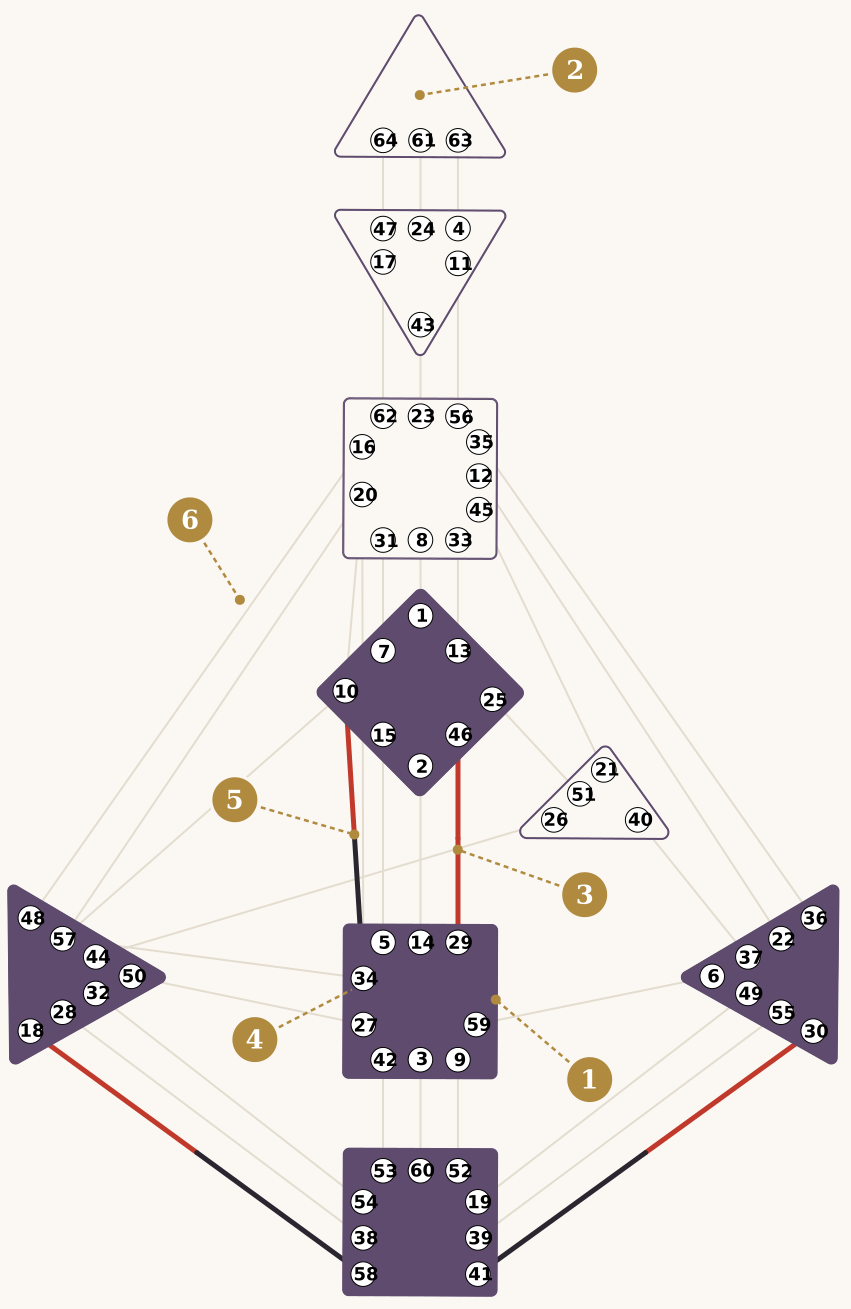
- A colored center is defined: a steady, consistent way that energy works in you. Here, the Sacral.
- A white center is open: where you take in and amplify energy from the people around you. Here, the Head.
- A channel: a line joining two centers, drawn in color only when the gates at both ends are active. This one, 29-46, is fully red.
- A gate number. Each of the 64 gates sits in a fixed spot inside one center. This is gate 34, in the Sacral.
- One channel, two colors: in channel 10-34, gate 10 comes from the red Design side and gate 34 from the black Personality side.
- A pale line: a channel that isn’t complete in this chart. Every chart shows all 36 possible channels; only some are switched on.
- Type
- Generator
- Strategy
- To respond
- Authority
- Emotional (Solar Plexus)
- Profile
- 6/2
- Definition
- Split
- Incarnation cross
- Left Angle, 11/12 | 46/25
Step 1: Type
Type is the first label on any chart, and everything else sits on top of it. It isn’t a personality category. It describes how your energy is built to engage: whether you carry a steady motor of your own, and whether that motor can push straight into action. There are five, and the chart decides which one you are mechanically, from which centers are defined and how they connect.
| Type | What the chart shows | Share of people |
|---|---|---|
| Generator | Sacral defined; no motor connected to the Throat | about a third |
| Manifesting Generator | Sacral defined, and a motor (Sacral, Heart, Solar Plexus or Root) connected to the Throat | about a third |
| Projector | Sacral open; no motor connected to the Throat; at least one center defined | about 20% |
| Manifestor | Sacral open; a motor (Heart, Solar Plexus or Root) connected to the Throat | about 8 to 9% |
| Reflector | No centers defined at all | about 1% |
Shares are the commonly cited figures and vary a little between sources.
In the example: the Sacral is colored and the Throat is white, so no motor can reach the Throat. That makes a Generator, not a Manifesting Generator. The difference between those two is a motor connected to the Throat, not the Sacral itself: both have it defined.
Step 2: Strategy
Each type comes with a strategy: the way that type is designed to enter decisions and new things without running into resistance. Next to it sit two feelings. The signature is how it feels when you’re living your strategy; the not-self theme is how it feels when you’re not.
| Type | Strategy | Signature | Not-self |
|---|---|---|---|
| Generator | To Respond | Satisfaction | Frustration |
| Manifesting Generator | To Respond, then inform | Satisfaction / freedom | Frustration + anger |
| Projector | Wait for the Invitation | Success | Bitterness |
| Manifestor | To Inform | Peace | Anger |
| Reflector | Wait a Lunar Cycle | Surprise | Disappointment |
Read the not-self theme as feedback, not as failure. For the example Generator, frustration is a signal to stop pushing and come back to responding to what life actually brings.
Step 3: Authority
Authority is where your reliable decisions come from, and it’s the most practical line on the chart. It follows a strict order: read down this list and stop at the first line that’s true for your chart.
- Solar Plexus defined: Emotional Authority, clarity arrives over time, across your emotional wave, not in the moment.
- Sacral defined: Sacral Authority, an in-the-moment gut response, a lift or a drop.
- Spleen defined: Splenic Authority, a quiet intuitive hit that speaks once.
- Heart defined and connected to the Throat or the G: Ego / Heart Authority, what you truly want and will put your willpower behind.
- G connected to the Throat: Self-Projected Authority, hearing yourself talk it through.
- Only Head, Ajna or Throat defined: Mental / Environment Authority, clarity forms through conversations in the right places.
- No centers defined: Lunar Authority, a full lunar cycle, about 28 days.
In the example: both the Sacral and the Solar Plexus are colored, and the Solar Plexus sits higher on the list. So this Generator has Emotional Authority, not Sacral. That’s the most common surprise in a first reading: about half of all people have an emotional authority, including many Generators, and for them the honest answer is often “let me sleep on it.”
Step 4: Profile
The profile is the pair of numbers such as 6/2 or 1/3. Each number is a line from 1 to 6. The first comes from the Sun in the black Personality column, the second from the Sun in the red Design column. That gives 12 profiles in total. The six lines, in a phrase each:
- Line 1, Investigator: needs a secure foundation; studies, researches, builds to bedrock. Insecurity until the ground is solid.
- Line 2, Hermit: natural at withdrawing to develop, then called out to share. Projected; alternates retreat and emergence.
- Line 3, Martyr: learns by trial and error; bonds and breaks bonds through direct experience. Resilient, experimental.
- Line 4, Opportunist: relies on network and friendships; influence and opportunity move through relationships. Foundation line.
- Line 5, Heretic: projected onto by others (people see a savior); brings practical, generalizable solutions. Reputation-sensitive.
- Line 6, Role Model: lives in three phases (trial-and-error to ~30, withdrawal/observation to ~50, then living as a role model). Aims to embody.
In the example: the Personality Sun reads 11.6 and the Design Sun reads 46.2. Take the line of each, 6 and 2, and you get the 6/2 profile.
Step 5: Defined and open centers
The nine shapes are the centers. A colored center is defined: that theme runs in a consistent, reliable way in you. A white center is open (also called undefined): you take in that energy from the people around you and often amplify it. Open isn’t empty or broken. It’s where you’re most sensitive, and where you can learn the most about other people.
| Center | What it’s about |
|---|---|
| Head Center | Inspiration, mental pressure, the questions that want thinking-about |
| Ajna Center | Conceptualizing, mental processing, certainty of view |
| Throat Center | Expression, manifestation, action |
| G Center (Identity) | Identity, love, direction in life |
| Heart Center (Ego / Will) | Willpower, self-worth, promises, material drive |
| Sacral Center | Life energy, work, sexuality, availability |
| Spleen Center | Intuition, health, fear, survival, the present moment |
| Solar Plexus Center | Emotions, feelings, moods, social/spiritual desire |
| Root Center | Stress, drive, pressure to get things done, adrenaline |
A useful way into the white centers: each center page has a not-self question, such as the Head’s “Am I trying to resolve questions that don’t actually matter to me?” For many people those questions are the most recognizable part of a first reading.
In the example: five centers are colored (G, Sacral, Spleen, Solar Plexus and Root) and four are white (Head, Ajna, Throat and Heart). The G center also goes by Identity or Self, and some charts, including our calculator, label it Self; the Heart is also called the Ego or Will center.
Step 6: Channels and gates
The small numbered circles are gates: 64 of them, each in a fixed spot inside one center and each drawn from one hexagram of the I Ching. A line between two centers is a channel, and there are 36 possible channels.
A channel is defined, and drawn in color, only when the gates at both ends are active in your chart. A defined channel is also what colors the two centers it joins. That’s the whole mechanism behind the centers: a center is defined when at least one defined channel reaches it.
A gate that’s active without its partner is often called a hanging gate. It doesn’t define a center on its own, but it’s still part of your chart. Some chart sites draw it as half a line; ours lists it among the activations.
In the example there are four channels: 10-34, 18-58, 29-46 and 30-41. Channels 10-34 and 29-46 join the G to the Sacral, 18-58 joins the Spleen to the Root, and 30-41 joins the Solar Plexus to the Root.
Step 7: The numbers, and red vs black
Next to the bodygraph, most charts print two columns of planets with 13 rows each: the Sun, the Earth, the two lunar nodes, the Moon, and Mercury through Pluto. That’s 26 activations. Each one is written as gate.line, so 34.1 means gate 34, line 1.
The black column (Personality) is calculated for the moment you were born and is usually described as the side you’re conscious of. The red column (Design) is calculated for the moment the Sun stood 88 degrees earlier in its path, about three months before birth, and is usually described as the side that runs below awareness, often easier for others to see than for you. A gate active from both sides counts once; some chart sites draw it striped.
| Planet | Personality | Design |
|---|---|---|
| Sun | 11.6 | 46.2 |
| Earth | 12.6 | 25.2 |
| North Node | 13.5 | 30.1 |
| South Node | 7.5 | 29.1 |
| Moon | 6.2 | 52.5 |
| Mercury | 54.3 | 18.1 |
| Venus | 41.3 | 44.5 |
| Mars | 34.1 | 46.5 |
| Jupiter | 52.4 | 52.6 |
| Saturn | 38.5 | 58.4 |
| Uranus | 58.2 | 10.4 |
| Neptune | 38.3 | 38.1 |
| Pluto | 1.4 | 1.1 |
So when a channel is half red and half black, one of its gates came from each column. In channel 10-34, gate 10 is active from the Design Uranus (10.4) and gate 34 from the Personality Mars (34.1).
Step 8: Definition
Definition describes how your colored centers hang together:
- Single: all defined centers form one connected group.
- Split: two separate groups.
- Triple split and quad split: three or four separate groups.
- No definition: nothing is defined. This is the Reflector.
A split is often described as two parts of you that link up more easily through other people. Treat that as a prompt to check against your own experience rather than a rule.
In the example: the G and Sacral form one group; the Spleen, Root and Solar Plexus form another. Nothing connects the two, so the definition is Split.
Step 9: Incarnation cross
The largest theme in a chart comes from just four gates: the Sun and Earth in the black column, and the Sun and Earth in the red column. It’s written as Personality Sun/Earth | Design Sun/Earth. The profile sets its geometry: most profiles give a Right Angle cross, 4/1 gives a Juxtaposition, and 5/1, 5/2, 6/2 and 6/3 give a Left Angle.
Read the cross as the backdrop and direction of your life experience, not as a fate. It’s also the part of the chart that pays off most once the basics feel familiar.
In the example: the Suns and Earths read 11 and 12 in black, 46 and 25 in red, and the 6/2 profile makes it a Left Angle cross: 11/12 | 46/25.
What to leave for later
Some parts of a chart are real but advanced. None of them change your type, strategy, authority or profile, so they can wait:
- The four small arrows beside the Head and Ajna, often called variables: a layer about how your body and mind are wired.
- The line-by-line meaning of every gate you carry.
- The finer divisions below the line, which charts sometimes list as color, tone and base.
How much your birth time matters
We tested this on our own calculator: 400 made-up birth moments between 1950 and 2010, each moved earlier and later by a set amount, counting how often each part of the chart changed.
| Time off by | Type | Authority | Profile | Centers |
|---|---|---|---|---|
| 15 minutes | 0.6% | 0.3% | 1.8% | 1.9% |
| 1 hour | 2.4% | 1.5% | 10.1% | 6.3% |
| 2 hours | 4.3% | 3.8% | 18.0% | 12.4% |
| 4 hours | 8.6% | 7.8% | 30.8% | 25.8% |
Type and authority hold up well. The profile is the first thing to move, because it depends on which line each Sun sits in, and the Sun spends only about a day in each line. If you don’t know your birth time, read your type and authority with reasonable confidence and hold the profile more loosely. Our free chart calculates for noon when no time is given, and flags any placement that sits right on a boundary.
Common reading mistakes
- Starting with the gates. Gate descriptions are the most fun to read and the least useful to act on. Type, strategy and authority come first.
- Reading white centers as weaknesses. Open means open to other people’s energy, not lacking.
- Treating red as hidden and black as real. Both columns are you; they come from two moments in time.
- Stopping at the Sacral. A colored Sacral doesn’t mean Sacral authority if the Solar Plexus is also colored.
- Using it as a forecast. A chart is a framework for reflection, not a prediction.
- Ranking charts. No type, profile or center is an upgrade on another.
Reading two charts together
A connection chart, sometimes called a composite, lays two bodygraphs over each other. It shows which channels switch on only when the two people are together, and where one person’s defined center meets the other’s open one. Read each chart on its own first, using the steps above: the combination makes far more sense once you know both types and both authorities. If you’d like a guided way through it, our Decode Your Connection mini-guide walks a pair through their two charts side by side.
Questions
What do the numbers on a Human Design chart mean?
The numbers inside the centers are the 64 gates, each in a fixed spot. In the two columns of planets, each entry is written as gate.line, so 34.1 means gate 34, line 1. The two numbers of your profile, such as 6/2, are the lines of your two Suns. More on the numbers.
What do the red and black lines mean?
Black is the Personality side, calculated for the moment of birth and usually described as the part you’re conscious of. Red is the Design side, calculated for about three months before birth and usually described as the part that runs below awareness. Both are equally you.
What does it mean if a center is white?
A white center is open (undefined). It isn’t missing or weak: it’s where you take in and often amplify energy from the people around you, and where you can learn a lot about them. More on centers.
Can I read my chart without an exact birth time?
Yes, with care. In our test, type and authority rarely changed when the birth time moved by an hour; the profile changed about one time in ten. See the numbers.
Is there a PDF version of this?
When you calculate your free chart, we email you a plain-English starter guide for your type as a PDF. It covers your type’s strategy, signature and not-self theme, with three small steps to try in your first week.
Is Human Design scientific?
No. Human Design hasn’t been validated as a science. It combines a few older systems, including astrology, the I Ching, the Kabbalah and the chakra system, into one map. We treat it as a structured prompt for self-reflection, not as a prediction or a diagnosis. What’s known and what isn’t.